| Mary Craig Ministries | |
| ïHome Page > Faith of Our Fathers |
 Search
|
About Us | News & Views | Missions | Healing, Deliverance... | Prophetic | Events | Favorite Places | Search |
| Mary Craig Ministries | |
| ïHome Page > Faith of Our Fathers |
|
About Us | News & Views | Missions | Healing, Deliverance... | Prophetic | Events | Favorite Places | Search |
Faith of Our Fathers
And the History of the United States
Updated July 2023
 |
|
All quotes are taken from www.wikipedia.org unless otherwise noted.
The purpose of this page is to link to sources of good information on the faith and "religious" beliefs of the founding fathers of the United States of America. There is a LOT of history here which is important to gaining an understanding of how the faith of our fathers moved them to accomplish the founding of the United States in the face of the most dangerous and impossible circumstances.
After the founders created the Constitution in 1787, it is reported that Benjamin Franklin was asked what sort of government the founders had given us. "A republic. If you can keep it," was his reply.
This gives some perspective on the progress over time to the faith of our founding fathers, as God granted it, and to the development of the nation and individual liberty for many along with the evil of enslavement of millions who would not gain freedom for hundreds of years. For a time, despite its many flaws, it became the most successful republic in history.
It would help for the reader to have an understanding of the "dark" or middle ages, the world of despot kings, nobles, surfs and slavery, empires and renaissance which preceded and led to the faith and pioneering accomplishment of the founding fathers, but that is not the scope of this project. I hope it will be somewhat helpful for those who are trying to find as accurate information as is possible on the faith of our fathers. It is incomplete, a work in progress, but a good start I believe. Feel free to email me using the link at the bottom. MCM's web manager 9/8/18
UPDATES
January 2022 It is now necessary to distinguish between extremist "Christian" views and strictly biblical views. We do not subscribe to Christian Dominionism, Christian nationalism or any other view that seeks to create or advocate for a Christian (a very loose term) earthly rule in any nation or the world apart from the literal return of Jesus Christ himself.
God is bringing people of all races, colors and people groups in/from all the nations into his kingdom by grace through faith in his Son, Jesus Christ. God does not put any people or ethnic groups above any others. Jesus is head of his Church, his pure and spotless bride, and all who are born again in Christ, born of God, are his children, his people. Our founding fathers, those who considered themselves to be Christians, generally had similar views. They did not believe in establishing a "Christian nation" or a nation of any other religion. But they also believed (as you will find below) that apart from Christian "religion" as taught in the Bible democracy would fail.
August 2021 There is a radical shift in the worldview sweeping the nation in the last few years which is being pushed by activists in almost every sector of society, government and our institutions. This includes serious anti-American activism throughout our educational institutions including radical rewriting of 400 years of U.S. history and culture. In the last two years major Internet platforms have been seriously censoring articles and information that espouse a conservative view of almost everything including our history. The articles linked to below existed and were fairly accurate for the most part as of 2015. Note that Wikipedia, which is used heavily here, is continually changing and is increasingly taking on a leftward perspective in line with mainstream media.
While political ideology is not the focus of this page, I, the webmaster, highly suggest reading about some key founders and philosophers of Communism -- whom current activist leaders and participants and many educators openly admit to and boast about following and subscribing to -- to understand what is going on in America right now. You will only understand the destructive agenda the current movement is increasingly imposing upon America if you have a biblically Christian or at least a solid, traditionally republican/democratic worldview. If you're not there the most important thing is having an eternal relationship with God through a new birth into eternal life in Jesus Christ (You may have to double-click on the video if it freezes.). More here.
If you have an understanding of the above, you should read Who is the Supreme Hegemon? by Dr. Mary Craig. The Wikipedia articles on Vladimir Lenin, Mao Tse Tung and Anthony Gramsci will give you even more. These men developed the ruthless methods to implement and enforce Marx's ideas. This will give you some understanding of what is going on in America right now. The activists and educators behind the current movement openly admit to following and propounding the teaching of these men and others like them in order to convert the nation from a true democratic republic based on biblical Christian values and being a light to the world (albeit with serious flaws) to their nationally destructive, anti-God, anti-America ideology. A far cry from the Christian worldview held by our founding fathers and by most of U.S. leadership and society until recently.
2018 As we today are going through a national crisis, may God save this republic as he created and intended it from the beginning, a great nation and light to the world (despite its many flaws), where all of its people are free under law, holding to biblical values, with the understanding that their life, freedoms and rights are derived from the one true and living God rather than from government, who seek to put God and their country first above themselves. One nation under God, indivisible, with liberty and justice (favor) for ALL.
Early Pre-Colonial History
(Democracy and Republicanism)
Democracy and Republicanism, early 500s B.C.: Republicanism is a democratic form of representative government. "...[The key point of Republicanism] is that the people hold popular sovereignty, rather than the people being subjects of a king.... Republicanism emerged as an identifiable theme in the Roman Republic (509 B.C.), where the founders of the Republic, Lucius Junius Brutus and Collatinus, denounced the former Roman Kingdom and had the Roman people declare a solemn oath never to allow a monarchy to return again.[1] The ideology practically vanished in ancient Rome and was revived in Renaissance Florence [in the European Middle Ages], and then in early modern Britain [1500s], in the British colonies in America in the causes of the American Revolution [1776], and in France during the French Revolution. [A series of bloody uprisings beginning in 1789 against the French monarchy by various opposing factions which established various unelected republics but devolved into civil and external wars, eventually taken over by Napoleon Bonaparte.] After 1800 it spread widely in Europe and European colonies. Republicanism in the United States has been a powerful force in that country since [the earliest colonial settlements in the 1600s and the revolution in] 1776."
. . ."In Ancient Greece [508-507 B.C.], several philosophers and historians analyzed and described elements we now recognize as classical republicanism. Some scholars have translated the Greek concept of "politeia" as "republic," but most modern scholars reject this idea. There is no single written expression or definition from this era that exactly corresponds with a modern understanding of the term "republic." However, most of the essential features of the modern definition are present in the works of Plato, Aristotle, and Polybius."
. . ."A number of Ancient Greek states such as Athens and Sparta have been classified as "classical republics", because they featured extensive participation by the citizens in legislation and political decision-making."
Republican or a "representative" form of government is somewhat in distinction to a pure or direct democracy in which the people directly vote on and participate in the implementation of most decisions of the group, city or nation and in the implementation of those decisions. Early Athens, Greece, 508-507 B.C., developed into the first direct democracy, though it did not remain strictly in this form for very long.
The concept of Republicanism practically vanished after its overthrow by Julius Caesar and subsequent Roman emperors until its development intermittently in Renaissance Florence in the 1100s.
Magna Carta 1215: "...also called Magna Carta Libertatum (the Great Charter of Freedoms), is an English legal charter, originally issued in the year 1215. It was written in Latin and is known by its Latin name. The usual English translation of Magna Carta is Great Charter.
Magna Carta required King John of England to proclaim certain rights (pertaining to freemen), respect certain legal procedures, and accept that his will could be bound by the law. It explicitly protected certain rights of the King's subjects, whether free or fettered — and implicitly supported what became the writ of habeas corpus, allowing appeal against unlawful imprisonment."
Magna Carta was arguably the most significant early influence on the extensive historical process that led to the rule of constitutional law today in the English speaking world. Magna Carta influenced the development of the common law and many constitutional documents, including the United States Constitution.[1]
Magna Carta was the first document forced onto an English King by a group of his subjects (the barons) in an attempt to limit his powers by law and protect their privileges. It was preceded by the 1100 Charter of Liberties in which King Henry I voluntarily stated that his own powers were under the law."Christopher Columbus: "Christopher Columbus (c. 31 October 1451 – 20 May 1506) was an explorer, colonizer, and navigator, born in the Republic of Genoa, in northwestern Italy.[2][3][4][5] Under the auspices of the Catholic Monarchs of Spain, he completed four voyages across the Atlantic Ocean that led to general European awareness of the American continents in the Western Hemisphere. Those voyages, and his efforts to establish permanent settlements in the island of Hispaniola, initiated the process of Spanish colonization, which foreshadowed the general European colonization of the 'New World'".
Columbus was a visionary and ruthless tyrant who enslaved and slaughtered the natives wherever he went. Most Catholic Europeans had the same mindset towards "heathens" (and Protestants). He is included here because he is the one God used, in spite of the evil, to discover and explore the Americas and ultimately open the way for settlement by both nominal and devoutly (if sometimes misguided) Christian groups from England. Much evil came with most of the "settlements" as well.
We believe that nations fall and rise as God wills, though he patiently waits and sends warnings for nations (including "ethnos"/people groups) to turn or turn back to him. Ultimately, all in heaven and earth belongs to him and he does as he wills. And that all is going according to his plan for the coming of Jesus Christ and HIS Kingdom. He will judge the nations and everyone based on what they have done with what he has revealed to them.
"The earth is the LORD’s, and all its fullness, The world and those who dwell therein." Ps. 24:1 "...All the inhabitants of the earth are reputed as nothing; He does according to His will in the army of heaven And among the inhabitants of the earth. No one can restrain His hand Or say to Him, “What have You done?” "In order that the living may know That the Most High rules in the kingdom of men, Gives it to whomever He will, And sets over it the lowest of men." "He makes nations great, and destroys them..." Dan. 4:27; 9:34 “Before Him all the nations are as nothing; they are regarded by Him as worthless and less than nothing. To whom, then, will you compare God?..." Isa. 40:17,18
Colonial History
The Beginnings 1600 to Early 1700s
The Jamestown Settlement (and the first democratic assembly) 1607: "Jamestown, located on Jamestown Island in the Virginia Colony, was founded on May 14, 1607.[1] It is commonly regarded as the first permanent English settlement in what is now the United States of America, following several earlier failed attempts." (From the article Jamestown, Virginia) "The Virginia House of Burgesses was the elected lower house in the legislative assembly established in the Colony of Virginia in 1619. Over time, the name came to represent the entire official legislative body of the Colony of Virginia, and later, after the American Revolution, the General Assembly of the Commonwealth of Virginia."
The Pilgrims 1620: Initially known as "Brownists", they were English Protestant separatists or dissenters who believed in separation from the Church of England. "Pilgrims (US), or Pilgrim Fathers (UK), is a name commonly applied to early settlers of the Plymouth Colony in present-day Plymouth, Massachusetts, United States. ...The colony, established in 1620, became the oldest continuously inhabited British settlement and the second successful English settlement (after the founding of Jamestown, Virginia in 1607) in what was to become the United States of America."
The Pilgrims were strict believers in the inspiration of and authority of the Bible for truth and revelation of the Christian faith according to the Protestant Reformed view and greatly influenced the religious and moral views of the colonies as they developed into a nation. They are sometimes confused with the Puritans. However they were religious "independents", not connected with any other religious group, and were severely persecuted in England for it. "The Pilgrims' story of seeking religious freedom has become a central theme of the history and culture of the United States."
William Bradford: William Bradford, the governor of the Plymouth Colony for most of it's existence, kept a journal, recording the events of the first 30 years of the colony. "It is Bradford's simple yet vivid account that has made the Pilgrims what Samuel Eliot Morison called the 'spiritual ancestors of all Americans'". William Bradford should be considered one of the most important founding fathers of what would become the thirteen colonies and the new nation. Besides Bradford's and the Pilgrims' spiritual and cultural influence on the developing nation, many famous Americans and American leaders throughout its history are descended from William Bradford and the Pilgrims.
Puritan Migration to New England: "Beginning around 1620, [the Puritans, not the same as the Pilgrims] came in family groups (rather than as isolated individuals) and were motivated chiefly by a quest for freedom to practice their Puritan religion" In the early decades, they held to their own exceedingly strict version of Reformed Protestantism. They are especially known for their establishment of the Massachusetts Bay Colony in 1628 as well as some of their perverted, rigid beliefs and practices leading to a period of persecution, imprisonment, torture and exile or execution of many who did not conform to their standards of "Christian life and practice" or who were accused of witchcraft, such as in the Salem witch hunts and trials and execution of Quakers.
. . .
"The Puritans created a deeply religious, socially tight-knit, and politically innovative culture that is still present within the modern United States. They hoped this new land would serve as a 'redeemer nation.' They fled England and in America attempted to create a 'nation of saints': an intensely religious, thoroughly righteous, community designed to be an example for all of Europe." Fortunately, most of the worst crimes and excesses in their colonies died out early. After realizing some of their worst failures, they "reformed" and produced some of the most brilliant theologians, scholars and political leaders of our time, greatly influencing the formation and character of the developing nation.Indentured servitude, oppression of and alliance with native Americans and the sale and enslavement of Africans was also introduced at this time. For a time, freed Africans and those of African decent had similar liberties to those of European decent. This changed as Europeans began to capitalize on and fear the rebellion of free and enslaved Africans. Europeans and Africans were also already being enslaved by the millions by other Africans, the Ottomans and Arab nations.
Divisions also developed among European Americans over the trade and enslavement of Africans. This would grow over the centuries to finally culminate in the American Civil War. The History Guy, Thomas Sowell.
The English "Glorious Revolution" of 1688: "The Glorious Revolution, also called the Revolution of 1688, was the overthrow of King James II of England (VII of Scotland and II of Ireland) in 1688 by a union of Parliamentarians with an invading army led by the [Protestant] Dutch stadtholder William III of Orange-Nassau (William of Orange) who, as a result, ascended the English throne as William III of England."
The English Bill of Rights 1689: "The Bill of Rights was passed by Parliament in December 1689. It was a re-statement in statutory form of the Declaration of Rights presented by the Convention Parliament to William and Mary in March 1689, inviting them to become joint sovereigns of England. It enumerates certain rights to which subjects and permanent residents of a constitutional monarchy were thought to be entitled in the late 17th century, asserting subjects' right to petition the monarch, as well as to have arms in defense. It also sets out—or, in the view of its drafters, restates—certain constitutional requirements of the Crown to seek the consent of the people, as represented in parliament."
"In the United Kingdom, the Bill of Rights is further accompanied by the Magna Carta, Habeas Corpus Act 1679 and Parliament Acts 1911 and 1949 as some of the basic documents of the uncodified British constitution. A separate but similar document, the Claim of Right Act, applies in Scotland. The English Bill of Rights 1689 inspired in large part the United States Bill of Rights.[4][5]"John Locke 1632-1704: "John Locke (29 August 1632 – 28 October 1704), widely known as the father of Enlightenment liberalism [now termed "classical liberalism" vs. the modern or "social" liberalism of today], was an English philosopher and physician regarded as one of the most influential of Enlightenment thinkers." "Classical" liberalism as it developed from the 1600s onward was a political philosophy or worldview founded on ideas of liberty, equality, individualism, property rights, free markets, religious toleration, the rule of law and limited government as opposed to the typical "absolutist state". Rule by absolute monarchs and elites/nobles was the common reality through the 1700s. John Locke's and other "liberal" (for that time) views were considered very radical. See a summary of Locke's works from Stanford Encyclopedia of Philosophy on John Locke. (I think the authors are mistaken in their comment that "Locke got Isaac Newton to write Newton's most powerful anti-Trinitarian tract" It is more likely that Isaac Newton, an outspoken anti-trinitarian, attempted to influence Locke with his strong anti-trinitarian views.)
The works of Locke cover medical practice, views on morality, republican government, law, justice, economics, political and social theory, religious tolerance and his views on Christianity and the Bible. He derived many of views from his Christian beliefs and background, human reason and from other "enlightenment" philosophers, especially Isaac Newton. His views are still considered radical for his time when there were no true democracies or republics and little concept of individualism. His involvement in English and colonial government diverged significantly from his theories. All of the U.S. founding fathers looked to and based much of their thinking and ideas on their understanding of Christianity and the Bible and on the works of John Locke, Francis Bacon and Isaac Newton.
(Regarding some of Locke's views relating to the Bible, see God, Locke, and Equality: Christian Foundations in Locke's Political Thought, by Jeremy Waldron, Pg. 44, et al. See also a helpful review, Servants of one Sovereign Master. Locke's philosophy included unbiblical/enlightenment concepts such as the view that humans were by nature rational and good (though his treatise on The Reasonableness of Christianity toward the end of his life seems to indicate that he believed or came to believe otherwise) and "equal distribution" -- not taken up by the Founding Fathers. He also believed that the natural "rights" of man were God-given. (See John Locke, Human Nature and God's Purposes.) Regarding the Trinity (and thus by implication, the deity of Christ), he insisted in a letter that in all of his works "there is not to be found any thing like an objection against the Trinity" nor was he sure of it one way or the other. See "A Letter to the Right Reverend Jonathan Edward, pg. 197 et al."))
American Enlightenment 1700s: "...For many decades the consensus was that liberalism [referring to classical liberalism, the Enlightenment version of modern-day libertarianism, as opposed to later social or modern liberalism], especially that of John Locke (as well as Bacon, Hooker, Sydney and Harrington), was paramount and that republicanism had a distinctly secondary role.[1] The new interpretations were pioneered by J.G.A. Pocock who argued in The Machiavellian Moment (1975) that, at least in the early eighteenth-century, republican ideas were just as important as liberal ones. Pocock's view is now widely accepted.[2]. Bernard Bailyn and Gordon Wood pioneered the argument that the Founding Fathers of the United States were more influenced by republicanism than they were by liberalism. Cornell University Professor Isaac Kramnick, on the other hand, argues that Americans have always been highly individualistic and therefore Lockean.[3]
In the decades before the American Revolution (1776), the intellectual and political leaders of the colonies studied history intently, looking for guides or models for good (and bad) government. They especially followed the development of republican ideas in England.[4]"
Also:
"Enlightenment philosophers [such as John Locke] chose a short history of scientific predecessors — Galileo, Boyle, and Newton principally — as the guides and guarantors of their applications of the singular concept of Nature and Natural Law to every physical and social field of the day. ... Monboddo and Samuel Clarke resisted elements of Newton's work, but eventually rationalized it to conform with their strong religious views of nature." Wikipedia article on Isaac Newton.
Christian Foundations 1700sJonathan Edwards 1703-1758: "Jonathan Edwards (October 5, 1703 – March 22, 1758), was a [Protestant Christian] preacher, theologian, and missionary to Native Americans. Edwards "is widely acknowledged to be America's most important and original philosophical theologian," and one of America's greatest intellectuals." He greatly influenced the developing colonies, nation and many of the founding fathers. The preaching and teaching of the gospel of Jesus Christ was his central focus. He railed against John Locke whom he called an "atheist" for his lack of orthodox views on salvation and the Trinity, though Locke actually agreed with some key orthodox Christian doctrines, such as the full inspiration of scripture, salvation through Jesus Christ alone (but with the Unitarianish view that in Christ's redemption, "all men" are saved vs Edwards' view that only the elect of God are saved) and the resurrection of Christ. (See John Locke's treatise, The Reasonableness of Christianity, As Delivered In the Scriptures and his defense against Jonathan Edward's writings against him.)
"Edwards’ theological work is broad in scope, but he was rooted in Reformed theology, the metaphysics of theological determinism, and the Puritan heritage. Recent studies have emphasized how thoroughly Edwards grounded his life's work on conceptions of beauty, harmony, and ethical fittingness, and how central The Enlightenment was to his mindset.[5]"
"Edwards' many eminent descendants have led some Progressive Era scholars to view Edward's progeny as proof of eugenics.... Edwards’ descendants have had a disproportionate effect upon American culture: his biographer George Marsden notes that 'the Edwards family produced scores of clergymen, thirteen presidents of higher learning, sixty-five professors, and many other persons of notable achievements.'[32]"
George Whitefield 1714-1770: George Whitefield (December 16, 1714 – September 30, 1770) was an Anglican/Methodist itinerant priest and preacher "who helped spread the Great Awakening in Great Britain and, especially, in the British North American colonies." "Known for his unorthodox ministry of itinerant open-air preaching" across New England and Georgia. Tens of thousands from across the colonies and beyond along with some of the founding fathers would come to hear Whitefield preach the gospel of Christ and the truths of the Bible in the open fields. Benjamin Franklin, a close friend of Whitefield, heard him often though he did not believe as Whitefield did.
First Great Awakening 1730s: "The First Great Awakening began in the 1730s. ... Leaders of the Awakening such as Jonathan Edwards and George Whitefield had little interest in merely engaging parishioners' minds; they wanted far more to elicit an emotional response [to the preaching of Christ] from their audience, one which might yield the workings and evidence of saving grace. ... Edwards, for instance, continued to preach an ardent and intellectual vision of Calvinism — his sermons contained "[both] transparent emotion, heartfelt sincerity,...[and] inexorable logic," which along with a sustained theme, could create quite the "cumulative impact."[2]" Edwards in fact believed that only the Holy Spirit could affect the work of salvation in sinners, that emotions were incidental to God's work of salvation.
Great Awakening - Influence on Political Life
"Joseph Tracy, the minister and historian who gave this religious phenomenon its name in his influential 1842 book The Great Awakening, saw the First Great Awakening as a precursor to the American Revolution. The evangelical movement of the 1740s played a key role in the development of democratic concepts in the period of the American Revolution.[3]" [From Wikipedia article Great Awakening]
Early Catalysts to the Revolution -- Early 1700s to 1774Samuel Adams 1722-1803: "(September 27 [O.S. September 16] 1722 – October 2, 1803) was a statesman, political philosopher, and one of the Founding Fathers of the United States. As a politician in colonial Massachusetts, Adams was a leader of the movement that became the American Revolution, and was one of the architects of the principles of American republicanism that shaped the political culture of the United States. He was a second cousin to John Adams."
"Born in Boston, Adams was brought up in a religious and politically active family. A graduate of Harvard College, he was an unsuccessful businessman and tax collector before concentrating on politics. As an influential official of the Massachusetts House of Representatives and the Boston Town Meeting in the 1760s, Adams was a part of a movement opposed to the British Parliament's efforts to tax the British American colonies without their consent."His 1768 circular letter calling for cooperation among the colonies prompted the occupation of Boston by British soldiers, eventually resulting in the Boston Massacre of 1770. To help coordinate resistance to what he saw as the British government's attempts to violate the British Constitution at the expense of the colonies, in 1772 Adams and his colleagues devised a committee of correspondence system, which linked like-minded Patriots throughout the Thirteen Colonies. Continued resistance to British policy resulted in the 1773 Boston Tea Party and the coming of the American Revolution."
"After Parliament passed the Coercive Acts in 1774, Adams attended the Continental Congress in Philadelphia, which was convened to coordinate a colonial response. He helped guide Congress towards issuing the Declaration of Independence in 1776, and helped draft the Articles of Confederation and the Massachusetts Constitution. Adams returned to Massachusetts after the American Revolution, where he served in the state senate and was eventually elected governor." Wikipedia
Samuel Adams' "Rights of the Colonists" (1772), the source for most of the "Declaration of Rights" of 1774, was the source for most of the Declaration of Independence written by Thomas Jefferson, (from Hanover.edu) and "...Adams was probably the author of most of the bill of rights." Encyclopedia Britannica 1911
"...Samuel Adams [was] a man who was both born for the times and who made the times; of whom it has been said, "It is impossible to write the history of the American Revolution without the character of Samuel Adams; it is impossible to write the life of Samuel Adams without giving a history of the Revolution, for he was the father of the Revolution." Harper's Magazine, Vol. 53 Pg. 188, 1876, A brief sketch of Samuel Adams
The Revolution and Founding of the United States of America
The Rift Intensifies 1750s to 1774
The American Revolution 1750s-1787: "Political and social developments, and the origins and aftermath of the war."
Samuel Adams and the English Tax Acts: "Samuel Adams emerged as an important public figure in Boston soon after the British Empire's victory in the Seven Years' War (1756–1763). Finding itself deep in debt and looking for new sources of revenue, the British Parliament sought, for the first time, to directly tax the colonies of British America. This tax dispute was part of a larger divergence between British and American interpretations of the British Constitution and the extent of Parliament's authority in the colonies."
The Boston and Chestertown Tea Parties
Boston Tea Party: The Boston Tea Party was a direct action by colonists in Boston, a town in the British colony of Massachusetts, against the British government. On December 16, 1773, after officials in Boston refused to [allow the return of] three shiploads of taxed tea to Britain, a group of colonists [disguised as Indians] boarded the ships and destroyed the tea by throwing it into Boston Harbor. Later the new nation paid Great Britain for the destroyed goods.Chestertown Tea Party (and Chestertown Resolves): The Chestertown Tea Party was a protest which may have taken place in May 1774 in Chestertown, Maryland as a response to the British Tea Act. Following suit of the more famous Boston Tea Party, colonial patriots boarded the brigantine Geddes in broad daylight and threw its cargo of tea into the Chester River.
The British "Intolerable Acts": "The Intolerable Acts or the Coercive Acts are names used to describe a series of five laws passed by the British Parliament in 1774 relating to Britain's colonies in North America. The acts triggered outrage and resistance in the Thirteen Colonies that later became the United States, and were important developments in the growth of the American Revolution."
First Continental Congress: "The First Continental Congress was a convention of delegates from twelve of the thirteen North American colonies that met on September 5, 1774, at Carpenters' Hall in Philadelphia, Pennsylvania, early in the American Revolution. Called in response to the passage of the Coercive Acts (also known as Intolerable Acts by the Colonial Americans) by the British Parliament, the Congress was attended by 56 members appointed by the legislatures of twelve of the Thirteen Colonies, the exception being the Province of Georgia, which did not send delegates."
The Revolutionary War 1775 to 1781The Battles of Lexington and Concord: "The battles of Lexington and Concord were the first military engagements of the American Revolutionary War. They were fought on April 19, 1775, in Middlesex County, Province of Massachusetts Bay, within the towns of Lexington, Concord, Lincoln, Menotomy (present-day Arlington), and Cambridge, near Boston. The battles marked the outbreak of open armed conflict between the Kingdom of Great Britain and its thirteen colonies in the mainland of British North America."
Thomas Paine's Common Sense pamphlet: "...First published anonymously on January 10, 1776, during the American Revolution. Common Sense, signed "Written by an Englishman", became an immediate success.[2] In relation to the population of the Colonies at that time, it had the largest sale and circulation of any book in American history. Common Sense presented the American colonists with a powerful argument for independence from British rule at a time when the question of independence was still undecided. Paine wrote and reasoned in a style that common people understood; forgoing the philosophy and Latin references used by Enlightenment era writers, Paine structured Common Sense like a sermon and relied on Biblical references to make his case to the people.[3] Historian Gordon S. Wood described Common Sense as, "the most incendiary and popular pamphlet of the entire revolutionary era".[4] Paine was close to atheism in his beliefs, though he used the Bible to convince the colonists of his views on independence.
Second Continental Congress: "The Second Continental Congress was a convention of delegates from the Thirteen Colonies that met beginning on May 10, 1775, in Philadelphia, Pennsylvania, soon after warfare in the American Revolutionary War had begun. It succeeded the First Continental Congress, which met briefly during 1774, also in Philadelphia. The second Congress managed the colonial war effort, and moved incrementally towards independence, adopting the United States Declaration of Independence on July 4th, 1776. By raising armies, directing strategy, appointing diplomats, and making formal treaties, the Congress acted as the de facto national government of what became the United States.[1] With the ratification of the Articles of Confederation in 1781, the Congress became known as the Congress of the Confederation."
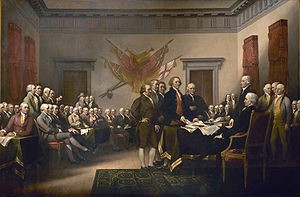
Declaration of Independence: "The United States Declaration of Independence is a statement adopted by the Continental Congress on July 4, 1776, which announced that the thirteen American colonies then at war with Great Britain were now independent states, and thus no longer a part of the British Empire. Written primarily by Thomas Jefferson [who drew primarily from the Declaration of Rights written by Samuel Adams Hanover.edu, Suite101], the Declaration is a formal explanation of why Congress had voted on July 2 to declare independence from Great Britain, more than a year after the outbreak of the American Revolutionary War. The birthday of the United States of America—Independence Day—is celebrated on July 4, the day the wording of the Declaration was approved by Congress."
The Declaration of Independence comes primarily from a report issued by a Massachusetts Committee of Correspondence led by Samuel Adams in 1772, convened for the purpose of issuing a report on the rights of the colonists under British rule.
"Samuel Adams," says Hutchinson, writing to a friend, " had prepared a long report, but he let Otis appear in it"; and again, in another letter: "the Grand Incendiary of the Province prepared a long report for a committee appointed by the town, in which, after many principles inferring independence were laid down, many resolves followed, all of them tending to sedition and mutiny, and some of them expressly denying Parliamentary authority.
"The report created a powerful sensation, both in America and in England, where it was for some time attributed to Franklin, by whom it was republished. It is divided into the three subjects specified in the original motion. The first, in three subdivisions, considering the rights of the Colonists as men, as Christians, and as subjects, was from the pen of Samuel Adams; his original draft, together with the preparatory rough notes or headings, being in perfect preservation. It is important, not only as a platform upon which were afterwards built many of the celebrated state papers of the Revolution, but as the first fruits of the Committee of Correspondence." Samuel Adams, The Rights of the Colonists The Report of the Committee of Correspondence to the Boston Town Meeting, Nov. 20, 1772 (Hanover Historical Texts Project)
During the signing of the Declaration of Independence, [Samuel] Adams proclaimed these words, “We have this day restored the Sovereign to whom all men ought to be obedient. He reigns in heaven and from the rising to the setting of the sun, let His kingdom come.” He stated, “I conceive we cannot better express ourselves than by humbly supplicating the Supreme Ruler of the World.”1 Heritage of the Founding Fathers
The Preamble to the Declaration:
We hold these truths to be self-evident, that all men are created equal, that they are endowed by their Creator with certain unalienable Rights,[71] that among these are Life, Liberty and the pursuit of Happiness. That to secure these rights, Governments are instituted among Men, deriving their just powers from the consent of the governed, That whenever any Form of Government becomes destructive of these ends, it is the Right of the People to alter or to abolish it, and to institute new Government, laying its foundation on such principles and organizing its powers in such form, as to them shall seem most likely to effect their Safety and Happiness.The Conclusion:
We, therefore, the Representatives of the united States of America, in General Congress, Assembled, appealing to the Supreme Judge of the world for the rectitude of our intentions, do, in the Name, and by Authority of the good People of these Colonies, solemnly publish and declare, That these United Colonies are, and of Right ought to be Free and Independent States...The American Revolutionary War: The effort by Congress and a usually ill-equipped, sometimes starving Continental Army to defeat the British Empire came close to failure and collapse more than once. Only by Divine intervention in numerous ways with men and nations in the right place at the right time did Washington and others with the help of France (and military leaders from Germany and Poland) prevail. "The American Revolutionary War (1775–1783) or American War of Independence[1] began as a war between the Kingdom of Great Britain and thirteen former British colonies in North America, and concluded in a global war between several European great powers."
First National Proclamation of Thanksgiving: "The First National Proclamation of Thanksgiving was given by the Continental Congress in 1777:
FOR AS MUCH as it is the indispensable Duty of all Men to adore the superintending Providence of Almighty God; to acknowledge with Gratitude their Obligation to him for Benefits received, and to implore such farther Blessings as they stand in Need of... It is therefore recommended to the legislative or executive Powers of these UNITED STATES to set apart THURSDAY, the eighteenth Day of December next, for SOLEMN THANKSGIVING and PRAISE: That at one Time and with one Voice, the good People may express the grateful Feelings of their Hearts, and consecrate themselves to the Service of their Divine Benefactor; and that, together with their sincere Acknowledgments and Offerings, they may join the penitent Confession of their manifold Sins, whereby they had forfeited every Favor; and their humble and earnest Supplication that it may please GOD through the Merits of JESUS CHRIST, mercifully to forgive and blot them out of Remembrance..."Valley Forge: "Valley Forge in Pennsylvania was the site of the military camp of the American Continental Army over the winter of 1777–1778 during the American Revolutionary War. ... Starvation, disease, malnutrition, and exposure killed nearly 2,500 American soldiers by the end of February 1778.[2]"
"On December 19, 1777, when Washington's poorly fed, ill-equipped army, weary from long marches, staggered into Valley Forge, winds blew as the 12,000 Continentals prepared for winter's fury. Only about one in three of them had shoes, and many of their feet had left bloody footprints from the marching.[3]""Undernourished and poorly clothed, living in crowded, damp quarters, the army was ravaged by sickness and disease. Typhoid, typhus, smallpox, dysentery, and pneumonia were among the numerous diseases that thrived in the camp during that winter. These diseases, along with malnutrition and exposure to the freezing temperatures and snow, contributed to the 2,500 soldiers that died by the end of the winter.[2]"
Gouverneur Morris of New York later stated that the Continentals were a 'skeleton of an army...in a naked, starving condition, out of health, out of spirits.'[9]
Soldiers deserted in 'astonishing great numbers' as hardships at camp overcame their motivation and dedication to fight for the cause of liberty. General James Mitchell Varnum warned that the desperate lack of supplies would 'force the army to mutiny.'[10]"Witnesses claim to have seen Washington in fervent and frequent prayer. This was one of lowest points of the Revolution. The quest for independence for the colonies and the end of British rule and "tyranny" seemed hopeless. At the same time, the fight for survival and the continuous training and drilling under the Prussian officer, Friedrich Wilhelm von Steuben, throughout the horrendous winter "forged" the previously poorly trained Continental Army into an effective fighting force.
"The winter at Valley Forge imbued into soldiers a strong will to persevere, endure, and later triumph over obstacles and bring independence to the United States. Washington always acknowledged that the perseverance gained by the soldiers at Valley Forge was what made the Continental Army bind together even stronger and eventually win the war.[20]"
The British Surrender at Yorktown and the End of the War: "The Siege of Yorktown or Battle of Yorktown in 1781 was a decisive victory by combined assault of American forces led by Major General George Washington and French forces led by General Comte de Rochambeau over a British Army commanded by Lieutenant General Lord Cornwallis. It proved to be the last major land battle of the American Revolutionary War. The surrender of Cornwallis's army prompted [the collapse of the British Parliament under Prime Minister Lord North] and the new British government's [decision to] negotiate an end to the conflict."
African Americans in the Revolutionary War: Around 9000 African American patriots -- making up around 15% of the Continental Army -- served, fought and died heroically in the American Revolutionary War. Most served far longer than other Americans, often for as long as the war lasted. The Revolutionary War and our independence could not have been won without them. They were promised their freedom for serving, but many were cruelly forced back into slavery after the war. It is estimated that at times African Americans made up to one quarter of some American regiments. James Armistead Lafayette was a extremely valuable double-agent for the Americans. Most native-born African Americans at the time tended to have a strong Christian faith, though sometimes mixed with beliefs from their African heritage.
"In the American Revolution, gaining freedom was the strongest motive for Black enslaved people who joined the Patriot or British armies. It is estimated that 20,000 African Americans joined the British cause, which promised freedom to enslaved people, as Black Loyalists. Around 9,000 African Americans became Black Patriots."
Some enslaved, such as Elizabeth Freeman in 1780, fought and won in court for the right to be free on the basis of their state constitutions and later in the Declaration of Independence, which state in various ways that "all men are created equal". Elizabeth's court victory in Massachusetts moved the state to abolish slavery which led to other Northern states doing the same soon afterwards. More... Elizabeth Freeman, Free Black People of Revolutionary America, African Americans in the American Revolution.
The "United - States" Become a NationWhat kind of Government? -- The Articles of Confederation: After writing, sending, and releasing the Declaration of Independence, which was written largely by Thomas Jefferson and adopted by the Second Continental Congress in Philadelphia in 1776, the 13 newly declared independent states created a permanent alliance to coordinate American efforts to win the Revolutionary War. This alliance, the United [but independent] States, was governed according to the Articles of Confederation and Perpetual Union, which was more of a treaty between independent countries than a national constitution. The Articles were adopted by the Second Continental Congress in 1777 but not finally ratified by all states until 1781. (Adapted from the Wikipedia article.)
Washington's Earnest Prayer after the end of Revolutionary War, June 14, 1783
"I now make it my earnest prayer that God would have you, and the State over which you preside, in his holy protection; that he would incline the hearts of the citizens to cultivate a spirit of subordination and obedience to government, to entertain a brotherly affection and love for one another, for their fellow-citizens of the United States at large, and particularly for brethren who have served in the field; and finally that he would most graciously be pleased to dispose us all to do justice, to love mercy, and to demean ourselves with that charity, humility, and pacific temper of mind, which were the characteristics of the Divine Author of our blessed religion, and without an humble imitation of whose example in these things, we can never hope to be a happy nation."
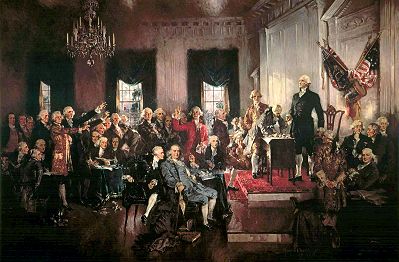
Washington was a 3rd degree Master Mason with a nominal "Christian" worldview.A New Government, A Constitution and a Republic -- The Constitutional Convention of 1787: The Constitutional Convention "took place from May 25 to September 17, 1787, in Philadelphia, Pennsylvania, to address problems in governing the United [sovereign] States of America, which had been operating under the Articles of Confederation following independence from Great Britain. Although the Convention was purportedly intended only to revise the Articles of Confederation, the intention of many of its proponents, chief among them James Madison and Alexander Hamilton, was from the outset to create a new government rather than fix the existing one." This contentious convention, presided over by General George Washington, led to the creation of the U.S. Constitution, the first 10 amendments to the Constitution and the formation of a republic governed by three branches -- Executive (President), Legislative (Congress, made up of House and Senate) and Judiciary (Supreme Court, made up of 9 justices).
National Constitution Center -- The U.S. Constitution: This is an excellent site that makes it very easy learn about our constitution and all of its parts.
The U.S. Civil War
The American Civil War: "The American Civil War (1861–1865), also known as the War Between the States as well as several other names, was a civil war in the United States of America. Eleven Southern slave states declared their secession from the United States and formed the Confederate States of America, also known as "the Confederacy". Led by Jefferson Davis, they fought against the United States (the Union), which was supported by all the free states and the five border slave states." It ultimately became a war pressed by Lincoln and the Union to end slavery. Both sides generally believed that God was on their side
Abraham Lincoln: was raised nominally Methodist. He was never a member of a church, rarely attended any and never outwardly claimed to be a Christian. He was a man of great integrity, but demonstrated little interest in or faith in Jesus Christ until his time in the Presidential office. Even then he never appears to have mentioned Jesus Christ in writing or speech, though he alluded to him. He probably did not consider himself to be a Christian until driven to the Bible and intense prayer by the pressures of the Presidency, national crisis and the Civil War. At that time almost everyone other than those of the Jewish faith, especially those in public office in North and South, were assumed to be Christians. Most of the nation (in the North at least) assumed him to be one, but the question and doubts came up at times during his campaigns.
By the time the nation was at the height of the Civil War when he appeared at the battlefield of Gettysburg after the horrific battle and after he had already lost two of his young sons, Edward and Willy, to illness, some of his closest acquaintances claim that they observed and heard from him of a religious conversion experience. (More on that below.)
While not one of the founding fathers, I have included him in this document because he is virtually the founder of a new nation out of the old. Lincoln developed and led the implementation of the form and ideals of our nation as it is today and the end of slavery based on his understanding of the vision of the founding fathers and on his increasing knowledge of the Bible and faith in God.
Some quotes from Abraham Lincoln...
Young Men's Lyceum Address, Springfield, IL, January 27, 1838
“At what point then is the approach of danger to be expected? I answer, if it ever reach us, it must spring up amongst us. It cannot come from abroad. If destruction be our lot, we must ourselves be its author and finisher. As a nation of freemen, we must live through all time, or die by suicide.”Abraham Lincoln's First Inaugural Address, March 4, 1861 at the beginning of the session of Southern states from the Union before the Civil War
...If it were admitted that you who are dissatisfied hold the right side in the dispute, there still is no single good reason for precipitate action. Intelligence, patriotism, Christianity, and a firm reliance on Him who has never yet forsaken this favored land are still competent to adjust in the best way all our present difficulty.Abraham Lincoln's Proclamation Calling Militia and Convening Congress on (15 April 1861)
And whereas it is fit and becoming in all people, at all times, to acknowledge and revere the Supreme Government of God; to bow in humble submission to his chastisements; to confess and deplore their sins and transgressions in the full conviction that the fear of the Lord is the beginning of wisdom; and to pray, with all fervency and contrition, for the pardon of their past offences, and for a blessing upon their present and prospective action... And whereas, when our own beloved Country, once, by the blessing of God, united, prosperous and happy, is now afflicted with faction and civil war, it is peculiarly fit for us to recognize the hand of God in this terrible visitation, and in sorrowful remembrance of our own faults and crimes as a nation and as individuals, to humble ourselves before Him, and to pray for His mercy, — to pray that we may be spared further punishment, though most justly deserved; that our arms may be blessed and made effectual for the re-establishment of law, order and peace, throughout the wide extent of our country; and that the inestimable boon of civil and religious liberty, earned under His guidance and blessing, by the labors and sufferings of our fathers, may be restored in all its original excellence:Abraham Lincoln's Emancipation Proclamation, 1862
According to Civil War historian James M. McPherson, Lincoln told Cabinet members that he had made a vow, a covenant with God, that if the Union drove the Confederacy out of Maryland, he would issue the Emancipation Proclamation.“When he’s asked [at a Cabinet meeting he had called to present his Proclamation] why he’s doing this,” Guelzo says, “the answer he says is: I made a vow, a covenant, with my maker, that if the Union army defeated the Confederate army in Maryland ... I would send a proclamation after them…" history.com
Abraham Lincoln's Proclamation of Amnesty and Reconstruction, 1863
If God now wills the removal of a great wrong, and wills also that we of the North as well as you of the South, shall pay fairly for our complicity in that wrong, impartial history will find therein new cause to attest and revere the justice and goodness of God.1863
When a pious minister told Lincoln he "hoped the Lord is on our side," the president responded, "I am not at all concerned about that.... But it is my constant anxiety and prayer that I and this nation should be on the Lord's side."[43] WikipediaAbraham Lincoln's Proclamation of Thanksgiving, Oct. 3, 1863
I do therefore invite my fellow citizens in every part of the United States, and also those who are at sea and those who are sojourning in foreign lands, to set apart and observe the last Thursday of November next, as a day of Thanksgiving and Praise to our beneficent Father who dwelleth in the Heavens.Abraham Lincoln's Gettysburg Address, Nov. 19, 1863, after the deadliest battle in American history
...that we here highly resolve that these dead shall not have died in vain—that this nation, under God, shall have a new birth of freedom—and that government of the people, by the people, for the people, shall not perish from the earth."Abraham Lincoln's Second Inaugural Address, March 4, 1865
Both [sides] read the same Bible, and pray to the same God; and each invokes His aid against the other. It may seem strange that any men should dare to ask a just God's assistance in wringing their bread from the sweat of other men's faces; but let us judge not that we be not judged. The prayers of both could not be answered; that of neither has been answered fully.After Abraham Lincoln's assassination
Noah Brooks, a newspaperman, and a friend and biographer of Lincoln's, in reply to Reed's inquiry if there was any truth to claims that Lincoln was an "infidel", stated:
In addition to what has appeared from my pen, I will state that I have had many conversations with Mr. Lincoln, which were more or less of a religious character, and while I never tried to draw anything like a statement of his views from him, yet he freely expressed himself to me as having 'a hope of blessed immortality through Jesus Christ.' His views seemed to settle so naturally around that statement, that I considered no other necessary. His language seemed not that of an inquirer, but of one who had a prior settled belief in the fundamental doctrines of the Christian religion. Once or twice, speaking to me of the change which had come upon him, he said, while he could not fix any definite time, yet it was after he came here, and I am very positive that in his own mind he identified it with about the time of Willie's death. He said, too, that after he went to the White House he kept up the habit of daily prayer. Sometimes he said it was only ten words, but those ten words he had. There is no possible reason to suppose that Mr. Lincoln would ever deceive me as to his religious sentiments. In many conversations with him, I absorbed the firm conviction that Mr. Lincoln was at heart a Christian man, believed in the Savior, and was seriously considering the step which would formally connect him with the visible church on earth. Certainly, any suggestion as to Mr. Lincoln's skepticism or Infidelity, to me who knew him intimately from 1862 till the time of his death, is a monstrous fiction -- a shocking perversion.[55] Wikipedia -- Religious Views of Abraham Lincoln
Harriet Tubman: Her last words were, "I go to prepare a place for you" (quoting Jesus from John 14). Enslaved from birth around 1822, severely injured, abused and about to be sold, she had an encounter with God and barely made her escape with the help of freed Blacks, abolitionists and churches in the Underground Railroad. Hers was a life of prayer, listening to and obeying God as she believed she was led by him. She never learned to read or write. Over her lifetime she was led by God, at continuously great cost to herself and risk to her life, to rescue over 800 slaves without losing one. She worked for the Union leading African American troops (the only woman to do so), as a scout and as a spy. During her lifetime she became connected with and was helped by other famous abolitionists and politicians including William Seward, Senator, Governor of New York and Secretary of State under Abraham Lincoln, John Brown, Frederick Douglass, Susan B. Anthony and others. She later joined the AME Church. She inspired the nation toward eventual emancipation of and caring for African Americans and the poor regardless of their backgrounds.
"Harriet Tubman (born Araminta Ross, c.?March 1822[1] – March 10, 1913) was an American abolitionist and social activist.[2][3] After escaping slavery, Tubman made some 13 missions to rescue approximately 70 enslaved people, including her family and friends,[4] using the network of antislavery activists and safe houses known collectively as the Underground Railroad." Wikipedia Recommended: Harriet Tubman's Road to Freedom, Harriet -- The Movie, Harriet-Tubman.org
June 19th Day / Juneteenth: Celebrated by African Americans and eventually by the entire nation as what would be a long beginning to an end of the evil institution of enslavement and oppression of African Americans. "Juneteenth (officially Juneteenth National Independence Day) is a federal holiday in the United States commemorating the emancipation of enslaved African Americans. Its name is a portmanteau of June and nineteenth, and it is celebrated on the anniversary of the order by Major General Gordon Granger proclaiming freedom for enslaved people in Texas on June 19, 1865 (two and a half years after the Emancipation Proclamation was issued)." See also, The Last Known Slave Ship, 60 Minutes
The United States is the only nation to have had a massive abolitionist movement and to have fought a civil war resulting in the eventual freedom of an enslaved population. Elsewhere in the world slavery continued and still continues in numbers surpassing that in the 1800s.
Original Documents
ThisNation.com: Very extensive and comprehensive coverage and original content, documents and political essays and speeches which lay the foundation for our republic and leading to our modern day concepts of what the United Sates of America is (or should be) as a nation from the Magna Carta, Mayflower Compact, Articles of Confederation, U.S. Constitution, Bill of Rights and Amendments through the latest news, documents and Supreme Court rulings today (including speeches and writings by Frederick Douglass, Davey Crockett, Martin Luther King, Ronald Reagan, Joseph Lieberman). Including a section on Federalism and the Federalist Papers and Antifederalist Papers in which the arguments for and against Federalism (stronger federal government vs.. states/individual rights) by the founding fathers were put forth leading up to the creation of the U.S. Constitution and tripartite/equal-powers government.
Constitution Society: "This site aims to eventually provide almost everything one needs to accurately decide what is and is not constitutional in most situations, and what applicable constitutions require one to do. It is for constitutional decision support."
Wikipedia: Bill of Rights: "The Bill of Rights is the name by which the first ten amendments to the United States Constitution are known.[1] They were introduced by James Madison to the First United States Congress in 1789 as a series of articles, and came into effect on December 15, 1791, when they had been ratified by three-fourths of the States. An agreement to create the Bill of Rights helped to secure ratification of the Constitution itself.[2]"
Constitution Society: Documentary History of the Bill of Rights
US Constitution Online: Other critical U.S. historical documents including Thomas Jefferson's wall of separation letter (from whence comes the commonly misunderstood statement relating to the 1st amendment, "There is a wall of separation between Church and state").
Archiving Early America: "Here you will discover a wealth of resources — a unique array of primary source material from 18th Century America. Scenes and portraits from original newspapers, maps and writings come to life on your screen just as they appeared to this country's forebears more than two centuries ago.
As you browse through these pages, you will find it easier to understand the people, places and events of this significant time in the American experience."WallBuilders: "Presenting America's forgotten history, patriarchs and heroes, with an emphasis on the moral, religious, and constitutional foundation on which America was built." In depth, documented books and articles by David Barton based on original documents and letters from our founders and others, with many of the original and/or quoted documents available on the site. In a departure from the norm, they also dig into Black history and the slavery issue which is vital to understanding our history and who we are as a nation.
Note that the accuracy of the message and research in the books, articles and media materials varies from good to poor in quality. A number of his quotations of the founding fathers are fabricated. (See Wikipedia on David Barton.) He lacks the balance of depicting the extent of non or partly Christian (mainly Masonic, Deistic, Judaic, and commercial/profit) influence, as is the case with most such endeavors by Christian authors that I'm aware of. (e.g. "I know of no country, indeed, where the love of money has taken stronger hold on the affections of men..." Tocqueville, emphasis mine)
If one is alert to these short-fallings, some of the best information and documentation on the preponderance of the Christian mindset in/biblical roots of our history can be found here. I highly recommend reading their About Us page. "...The propitious [favorable] smiles of heaven can never be expected on a nation which disregards the eternal rules of order and right which heaven itself has ordained," George Washington. Also highly recommended original sources: Democracy in America by Tocqueville (or see some key quotations), The Federalist Papers, The Anti-Federalist Papers. The web manager
American Experiment: 'A republic, if you can keep it' ... or remember what that means: On what form of government we have.
What Our Founding Fathers Believed
/ The Faith of Our Fathers
This section is incomplete so far. Info on Jefferson,
Hamilton, S. Adams, J. Adams, Madison and others will be coming.
Most of our founding fathers (besides most of the colonists) publically spoke, proclaimed, wrote as and considered themselves to be Christians and most were believers in and students of the Bible and believers in the God of the Bible as they understood it. Many in government, education and leadership today claim that the United States of America was not founded on Christian values or principles and that few of the founding fathers were serious Christians. It is true that many had Deistic views and some were Freemasons, usually with a Christian/Enlightenment worldview -- See The Problem with America's Roots by Dr. Mary Craig. Most of the founding fathers based their political views of government on the works of John Locke (who in fact considered himself to be an orthodox Christian and defended Christianity and the need for religious values) and the other Enlightenment philosophers (see another view of the Enlightenment philosophers). Good research will show that most of our founding fathers and colonialists believed to varying degrees (from liberal to fervently orthodox) in Jesus Christ as revealed in the New Testament and believed in the Bible as the inspired word of God and to be the ultimate authority for truth and life. Most considered themselves to be true Christians as they understood it. The general mindset of the nation concerning Christianity waxed and waned at various times but most expected their leaders to be Christians in some form until the 1960s.
Note that the current president (2009) himself has never said, so far, that America was never a Christian nation; but that America "is no longer a Christian nation" (with the presumption that it was). In fact, nations cannot actually be "Christian" -- individuals are -- though nations can be founded upon and governed by Christian/Biblical principles.
Important Articles
These articles are fairly balanced regarding the founding fathers and how the nation was founded
The Founding Fathers, Religion, and God -- U.S. News & World Report: "The Constitution has only one direct reference to God—"In the year of our Lord"—but Baylor University history professor Thomas S. Kidd argues that religion played a much larger role in influencing the ideas and principles that became bedrocks of the nation..."
Was America Founded As A Christian Nation? -- Forbes: "Few matters ignite more controversy than America ’s Christian roots. The issue reverberates anew this electoral season [2015] where the faiths of both major candidates have been questioned. Religion imbues politics.... As historian John Fea notes, “If the Treaty of Tripoli is correct, and the United States was not ‘founded on the Christian religion,’ then someone forgot to tell the American people… The idea that the United States is a ‘Christian nation,’ has always been central to American identity.” But debate rages over whether the Founders were Deists and why the Constitution bears no mention of God."
(Note that the Treaty of Tripoli including the "not founded on the Christian religion" statement, in the English translation, was unanimously ratified by the U.S. Senate in 1797. With no navy, the new nation had to defer to the Pasha/ruler of the Muslim Barbary pirates of Tripoli who demanded huge tribute payments to stop them from capturing American ships and enslaving their crews. In London, when asked by America's ambassador -- why the hostility against America, the Barbary ambassador quoted a verse from the Koran as their basis for enslavement and subjugation of Christians. The hostility of Muslim pirate nations toward "Christian" nations was not unknown to American leaders. Hence the American government's interest in appealing to the pirates as not being a "Christian-founded" nation (nice try -- the Barbaries knew better). After the U.S. built a navy and defeated the Barbary nations in 1801, a subsequent treaty was negotiated and ratified without this statement.)
Freemasonry and the Founding FathersFreemasonry accepts most "religions", requires some form of religious faith and practice and requires belief in a "supreme being". The secret society is ultimately completely "anti-Christ" (in the sense of the Greek word antichristos -- like/counterfeit Christ, hence opposed to the true Jesus Christ of the Bible). Most members of Freemasonry in the Revolutionary period were "Christians" of every stripe from nominal to very serious, some Jewish, and some Christian/deist. George Washington was Episcopalian (Anglican), held Christian-oriented Deist views and was a dedicated Mason (3rd degree Master Mason).
In truth, one cannot be a true Christian as defined in the Bible and participate knowingly in Freemasonry. In the Bible, God accepts no other worship than to Himself and to his Son, Jesus Christ. Some, upon discovering this, leave Freemasonry to follow Christ.
Known Founding Fathers Who Were Freemasons:
Early Presidents: George Washington, James Monroe, Andrew Jackson.
Famous early Americans: Benjamin Franklin, John Hancock, Paul Revere, Benedict Arnold, Stephen Austin, Jim Bowie, David Crockett, and Sam Houston.
Famous names from the American Revolution:
Ethan Allen, Edmund Burke, John Claypoole, William Daws, Benjamin Franklin, John Hancock, John Paul Jones, Robert Livingston, James Madison, Paul Revere, Colonel Benjamin Tupper.
Masonic Influences
Lafayette, French liaison to the Colonies, without whose aid the war could not have been won. The majority of the commanders of the Continental Army, and members of "Army Lodges." Most of Washington's Generals were Freemasons.A good article on the subject: What are America's True Roots?
From CBS News, 9 Things You Didn't Know About Freemasons:
Most of the Founding Fathers were not Freemasons (emphasis the webmaster's). Many leading figures in the American Revolution -- including John and Samuel Adams, Thomas Jefferson, James Madison and Thomas Paine -- were not Masons.
Of the 56 figures who signed the Declaration of Independence, nine were confirmed "Christian" Masons, according to the Grand Lodge of Pennsylvania; and of the 39 delegates of the Continental Congress who signed the draft of the new nation's Constitution in 1787, 13 (one-third) were Freemasons. It's sad that even this many of our founders -- including our first President -- were Masons. All it takes is a seed for the weed to grow and infect a nation. This was one bad seed of many.What They Believed -- Gleanings
George Washington
President George Washington's First Inaugural address to Congress, April 30, 1789
In this address to Congress by the first and newly elected President, George Washington, you can see the kind of faith he had. He was a 3rd degree Master Mason who believed himself to be a good-standing, yet unworthy Christian along with his fellow founders and citizens created and led by the "Divine Author of our blessed religion". His faith was not so much in the God of the Bible, though some of the beliefs he held to come from the Bible. It was what he knew and believed. It was this "Almighty Being" to whom he continually prayed and put his hope in. His was a deep faith in "the Almighty Being", "the Great Author", "the Invisible Hand", the "One in Heaven", the "Benign parent of the human race". All terms and concepts of the god of Freemasonry with a Judea-Christian slant. The god of Freemasonry is in fact antichrist (anti-the true Jesus Christ of the Bible) and luciferic. Few in the Masonic movement, including true Christians, are aware of this until and unless they reach the highest degree of one of the "rites". See The Problem with America's Roots by Dr. Mary Craig.
Such being the impressions under which I have, in obedience to the public summons, repaired to the present station, it would be peculiarly improper to omit, in this first official act, my fervent supplications to that Almighty Being who rules over the universe, who presides in the councils of nations and whose providential aide can supply every human defect, that His benediction may consecrate to the liberties and happiness of the people of the United States a Government instituted by themselves for these essential purposes; and may enable every instrument employed in its administration to execute with success, the functions allotted to his charge.
In tendering this homage to the Great Author of every public and private good, I assure myself that it expresses your sentiments not less than my own; nor those of my fellow-citizens at large, less than either. No people can be bound to acknowledge and adore the Invisible Hand which conducts the affairs of men more than the people of the United States.
Every step by which they have advanced to the character of an independent nation seems to have been distinguished by some token of providential agency; and in the important revolution just accomplished in the system of their United government, the tranquil deliberations and voluntary consent of so many distinct communities, from which the event has resulted can not be compared with the means by which most governments have been established, without some return of pious gratitude, along with an humble anticipation of the future blessings which them past seem to presage.
These reflections, arising out of the present crisis, have forced themselves too strongly on my mind to be suppressed. You will join with me I trust in thinking, that there are none under the influence of which the proceedings of a new and free Government can more auspiciously commence.
We ought to be no less persuaded that the propitious smiles of Heaven can never be expected on a nation that disregards the eternal rules of order and right which Heaven itself has ordained; and since the preservation of sacred fire of liberty and the destiny of the republican model of government are justly considered as deeply, perhaps finally, staked of the experiment...
I shall take my present leave; but not without resorting once more to the Benign Parent of the Human Race, in humble supplication that, since He has been pleased to favor the American people with opportunities for deliberating in perfect tranquility, and dispositions for deciding with unparalleled unanimity on a form of government for the security of their union and the advancement of their happiness, so His divine blessings may be equally conspicuous in the enlarged views, the temperate consultations and the wise measures on which the success of this Government must depend.Washington was very disciplined, religious and sincere in his thought and speech. He considered the new nation as having come about by and being totally dependent on God as he understood him. Yet the Masonic god he believed in was not the same as the One True and Living God and Savior as revealed in the Bible. He nevertheless considered his faith to be Christian and the new nation to be as well.
On the issue of slavery when this evil was considered to be the norm in the Colonies and the Western, African and Arabic world:
"Despite having been an active slave holder for 56 years, George Washington struggled with the institution of slavery and spoke frequently of his desire to end the practice. At the end of his life, Washington made the decision to free all his slaves in his 1799 will - the only slave-holding Founding Father to do so."
www.mountveron.orgSamuel Adams
Faith of Our Fathers: Samuel Adams: "Samuel Adams lived from September, 1722, to October 2, 1803. This patriot leader suffered otherwise shattering losses, his first wife and four of their children dying of natural causes before the Revolutionary War began. A close friend was decapitated, his head presented as a trophy to the British commanding general. He spent nearly three years at the Congress in Philadelphia separated from his family. His house was vandalized by British troops. He was targeted by the British crown for his stance for America's independence, and more.
"Samuel Adams saw himself as a conserver of the New England Puritan tradition. He was ahead of his time; for example, he declined to accept a slave as a gift, appealed to the American Indians for aid in the Revolution, and extended public education in Massachusetts to girls. He has become a "mostly forgotten" founder, though Thomas Jefferson called him "truly the Man of the Revolution" and many credit him as the Father of America more than George Washington...."
References to the above quotations are from a source that can no longer be found as of 2023.
More on Samuel Adams:
Samuel Adams' leading role in all spheres of public life and politics towards freedom, liberty, independence and republican government, heavily influenced all of the founding fathers, the people of Colonial America and the entire collection of newly formed governing bodies at the time of the Revolution, including the Massachusetts gatherings, committees, assemblies and legislatures, the first and second Continental Congresses and the their committees along with the ideas in and issuance of the Declaration of Independence. He continued in a leading role after the Revolution as a member of Congress with his participation in the formation of the first confederated government of the states. Leading up to the Revolution, "He wrote constantly for years in the Boston Gazette under a list of pseudonyms as long as your arm. He was a wholesale voice-vendor of ideas of freedom and liberty, whatever his particular jobs. His ideas run throughout the freedom documents." (Rev. Jim Craig)
Samuel Adams drew heavily for his political ideas from the Bible, John Locke, Bacon, Hooker, Sydney, Harrington, the Magna Carta, the English Bill of Rights and the unwritten British Constitution. His entire worldview came from his knowledge of God, Jesus Christ as God the Son, the Savior and Lord, and the values and teaching of the Bible. He was continually energized and motivated by his faith in the living God of the Bible and his belief in the rightness of the cause for liberty, freedom and law as given by God.
In 1776 Adams opposed Mass. Royal Gov./General Thomas Gage in the midst of a large Boston town meeting of thousands before the Battle of Lexington (which started the Revolutionary War). Gage had occupied Boston with thousands of British soldiers. He warned Adams to "make your peace with the king (George)" and also tried to bribe him with a high paying position working for the British. "Sir," replied Adams, "I trust I have long since made my peace with the King of kings." He then proceeded to give General Gage a counter-warning of the danger he was in if he did not remove his troops from Boston at once. Gage gave in and withdrew the troops. Later, under orders from the British Prime Minister, Gage sent troops to Lexington (where Adams was staying with Hancock) to round up colonial stores of arms and ammunition and possibly to arrest Adams and Hancock. The Prime Minister's orders were, if he captured them, to send them to England to be tried for treason for their leadership in the "rebellion" against Parliament and the king.
Thomas Jefferson, “…considered him [Samuel Adams] as more than any other member in Congress, the fountain of our important measures. In mediating the matter of that address, I asked myself, is this exactly in the spirit of the patriarch of liberty, Samuel Adams? He was the Father of the Revolution.”
On October 2, 1803, Samuel Adams passed away. In his will he wrote, “Principally, and first of all, I resign my soul to the Almighty Being who gave it, and my body I commit to the dust, relying on the merits of Jesus Christ for the pardon of my sins.”1 Heritage of the Founding Fathers
A brief sketch of Samuel Adams and his times, Harper's Magazine, June 1876
Samuel Adams: A Life by Ira StollJohn Adams
John Adams' Religious Views: First vice president of the United States under George Washington, second President of the United States. John Adams, while holding a fervent belief in and reverence for God and Jesus Christ, rejected the idea of divine inspiration of the Bible and the deity of Christ. "Fraser argues that Adams' "theistic rationalism, like that of the other Founders, was a sort of middle ground between Protestantism and deism."[123] By contrast, David L. Holmes has argued that John Adams, beginning as a Congregationalist, ended his days as a Christian Unitarian, accepting central tenets of the Unitarian (vs. orthodox) creed but also accepting Jesus as the redeemer of humanity and the biblical account of his miracles as true.[124] In common with many of his Protestant contemporaries, Adams criticized the claims to universal authority made by the Roman Catholic Church.[125] In 1796, Adams denounced political opponent Thomas Paine's criticisms of Christianity in his Deist book The Age of Reason, saying, "The Christian religion [as he understood it] is, above all the religions that ever prevailed or existed in ancient or modern times, the religion of wisdom, virtue, equity and humanity, let the Blackguard Paine say what he will."[126]"
Quotations from John Adams
But should the people of America once become capable of that deep simulation towards one another, and towards foreign nations, which assumes the language of justice and moderation, while it is practising iniquity and extravagance, and displays in the most captivating manner the charming pictures of candour, frankness, and sincerity, while it is rioting in rapine and insolence, this country will be the most miserable habitation in the world. Because we have no government, armed with power, capable of contending with human passions, unbridled by morality and religion. Avarice, ambition, revenge and licentiousness would break the strongest cords of our Constitution, as a whale goes through a net. Our Constitution was made only for a moral and religious people. It is wholly inadequate to the government of any other.
Letter to the Officers of the First Brigade of the Third Division of the Militia of Massachusetts, 11 October 1798, in Revolutionary Services and Civil Life of General William Hull (New York, 1848), pp 265-6.I have thought proper to recommend, and I do hereby recommend accordingly, that Thursday, the 25th day of April next, be observed throughout the United States of America as a day of solemn humiliation, fasting, and prayer; that the citizens on that day abstain as far as may be from their secular occupations, devote the time to the sacred duties of religion in public and in private; that they call to mind our numerous offenses against the Most High God, confess them before Him with the sincerest penitence, implore His pardoning mercy, through the Great Mediator and Redeemer, for our past transgressions, and that through the grace of His Holy Spirit we may be disposed and enabled to yield a more suitable obedience to His righteous requisitions in time to come; that He would interpose to arrest the progress of that impiety and licentiousness in principle and practice so offensive to Himself and so ruinous to mankind; that He would make us deeply sensible that "righteousness exalteth a nation, but sin is a reproach to any people;" . . . and that he would extend the blessings of knowledge, of true liberty, and of pure and undefiled religion throughout the world.
Presidential proclamation of a national day of fasting and prayer (6 March 1799)The general principles on which the fathers achieved independence, were ... the general principles of Christianity, in which all those sects were united, and the general principles of English and American liberty, in which all those young men united, and which had united all parties in America, in majorities sufficient to assert and maintain her independence. Now I will avow, that I then believed and now believe that those general principles of Christianity are as eternal and immutable as the existence and attributes of God; and that those principles of liberty are as unalterable as human nature and our terrestrial, mundane system.
Letter to Thomas Jefferson, 28 June 1813. Often misquoted as "The general principles on which the fathers achieved independence were the general principles of Christianity"There exists, I believe, throughout the whole Christian world, a law which makes it blasphemy to deny or doubt the divine inspiration of all the books of the Old and New Testaments, from Genesis to Revelations. . . . I think such laws a great embarrassment, great obstructions to the improvement of the human mind. Books [of the Bible] that cannot bear examination, certainly ought not to be established as divine inspiration by penal laws. It is true, few persons appear desirous to put such laws in execution, and it is also true that some few persons are hardy enough to venture to depart from them. But as long as they continue in force as laws, the human mind must make an awkward and clumsy progress in its investigations. I wish they were repealed. The substance and essence of Christianity, as I understand it, is eternal and unchangeable, and will bear examination forever, but it has been mixed with extraneous ingredients, which I think will not bear examination, and they ought to be separated. [We believe in the divine inspiration of the entire Bible as originally written, but there is no place for man-made laws concerning the Bible, for or against! The web manager]
Letter to Thomas Jefferson (23 January 1825), published in Letters: The Complete Correspondence Between Thomas Jefferson and Abigail and John Adams (UNC Press, 1988), p. 607Major Greene this evening fell into some conversation with me about the Divinity and satisfaction of Jesus Christ. All the argument he advanced was, "that a mere creature or finite being [as opposed to a divine being] could not make satisfaction to infinite justice for any crimes," and that "these things are very mysterious."
Thus mystery is made a convenient cover for absurdity. Entry of 13 February 1756 in Charles Francis Adams, The Works of John Adams, Second President of the United States: With a Life of the Author, Notes, and Illustrations vol. 2 (Boston: Charles C. Little and James Brown, 1850) 4, Google Books, 13 Dec. 2010 [This statement by Adams shows that he did not believe in the divinity of Christ or in the Divine requirement of eternal satisfaction (payment) for our sins by a divine being. Without the knowledge of these facts there is no true knowledge of God or of true Christianity as revealed in the Bible. The web manager]
Thomas Jefferson"Baptized in his youth, Jefferson became a governing member of his local Episcopal Church in Charlottesville, which he later attended with his daughters.[331] Jefferson, however, spurned metaphysical claims of Christianity.[332] Influenced by Deist authors during his college years, Jefferson abandoned "orthodox" Christianity after his review of New Testament teachings.[333][334] Jefferson has sometimes been portrayed as a follower of the liberal religious strand of Deism that values reason over revelation.[335] Nonetheless, in 1803, Jefferson asserted, 'I am Christian, in the only sense in which [Jesus] wished any one to be.'[220]
"Jefferson later defined being a Christian as one who followed the simple teachings of Jesus. Influenced by Joseph Priestly,[335] Jefferson selected New Testament passages of Jesus' teachings into a private work he called The Life and Morals of Jesus of Nazareth, known today as the Jefferson Bible, never published during his lifetime.[336][337] Jefferson believed that Jesus' message had been obscured and corrupted by Paul the Apostle, the Gospel writers and Protestant reformers.[335] Peterson states that Jefferson was a theist "whose God was the Creator of the universe ... all the evidences of nature testified to His perfection; and man could rely on the harmony and beneficence of His work."[338] In a letter to John Adams, Jefferson wrote that what he believed was genuinely Christ's, found in the Gospels, was "as easily distinguishable as diamonds in a dunghill".[339] By omitting miracles and the resurrection, Jefferson made the figure of Jesus more compatible with a worldview based on reason.[340]
"Jefferson was firmly anticlerical, writing in "every age, the priest has been hostile to liberty ... they have perverted the purest religion ever preached to man into mystery and jargon."[341] ... Early in 1802, Jefferson wrote to the Danbury Connecticut Baptist Association [in response to their letter to him regarding their concern that their state government could interfere with the practice of their religion], "that religion is a matter which lies solely between Man and his God." He interpreted the First Amendment as having built "a wall of separation between Church and State."[347] The phrase 'Separation of Church and State' has been cited several times by the Supreme Court in its interpretation of the Establishment Clause.""Jefferson donated to the American Bible Society, saying the Four Evangelists delivered a "pure and sublime system of morality" to humanity. He thought Americans would rationally create "Apiarian" religion, extracting the best traditions of every denomination.[348] And he contributed generously to several local denominations near Monticello.[349] Acknowledging organized religion would always be factored into political life for good or ill, he encouraged reason over supernatural revelation to make inquiries into religion. He believed in a creator god, an afterlife, and the sum of religion as loving God and neighbors. But he also controversially rejected fundamental Christian beliefs, denying the conventional Christian Trinity, Jesus' divinity as the Son of God and miracles, the Resurrection of Christ, atonement from sin, and original sin.[350][351][352] Jefferson believed that the original sin was a gross injustice and that God did not condemn all of humanity by the transgression of Adam and Eve in the Garden of Eden.[353]
"Jefferson's unorthodox religious beliefs became an important issue in the 1800 presidential election.[354] Federalists attacked him as an atheist. As president, Jefferson countered the accusations by praising religion in his inaugural address and attending [Episcopalian] services at the Capitol.[354]" Wikipedia - Thomas Jefferson's Political, Social and Religious ViewsThe "Wall of Separation Between Church and State"
It began with a letter from the Danbury Baptist Association to newly elected President Thomas Jefferson in which the Baptist association expressed their "concern over the lack in their state constitution of explicit protection of [their] religious liberty, and against a government establishment of religion." Wikipedia -- Baptists in the History of Church and State In Jefferson's reply, he assured them "that the United States Bill of Rights prevents the establishment of a national church, and in so doing they did not have to fear government interference in their right to expressions of religious conscience." Wikipedia - Separation of Church and StateThomas Jefferson's letter and statement on separation had nothing to do with keeping religion out of government, as is commonly thought today. Jefferson's statement on separation has been turned on its head in recent years. Jefferson's statement on separation never opposed the practice and free exercise of religion in government. Nor did any other founder or anyone else in federal or state government oppose the free exercise of religion in government. To the contrary, Judeo Christian religious expression (good and bad) was prevalent and unhindered throughout the new nation in and out of government. This was the state of Judeo Christian religion in early America which was considered constitutional, normal and protected under the First Amendment by Thomas Jefferson and all the founders and the American people. (Note that the constitution in this regard was created not to grant the delineated rights but to recognize what Jefferson and the other founders considered to be the God-given rights of the people.)
Complete texts of Danbury's and Jefferson's letters
Founding Fathers -- Religious AffiliationsFaith of Our Fathers: Brief summaries of what many of our founding fathers believed.
Religious affiliation of the Founding Fathers: Tables and summaries of the religious affiliation and background of the Founding Fathers. Note that the Deistic and Masonic views and affiliations of Washington and others is missing. (Though Washington after the Revolution publically renounced his affiliation with the Masons.) My understanding so far is that the overall corrections to the listing and summary in this regard, while needed (See The Problem with America's Roots), would not be significant. (The website manager)
Wikipedia: Founding Fathers: Discussion and list of the American revolutionary founding fathers.
Alexis de Tocqueville -- Democracy and Religion in America 1835Alexis de Tocqueville, 1835, French political thinker, historian and student of early post-revolutionary America: visited the new nation from France and recorded his experience and analysis of what he found, especially regarding Democracy and Christianity in America.
Alexis-Charles-Henri Clérel de Tocqueville (29 July 1805, Paris – 16 April 1859, Cannes) was a French political thinker and historian best known for his Democracy in America (appearing in two volumes: 1835 and 1840) and The Old Regime and the Revolution (1856). In both of these works, he explored the effects of the rising equality of social conditions on the individual and the state in western societies. Democracy in America (1835), his major work, published after his travels in the United States, is today considered an early work of sociology and political science.
Moreover, almost all the sects of the United States are comprised within the great unity of Christianity, and Christian morality is everywhere the same. In the United States the sovereign authority is religious, and consequently hypocrisy must be common; but there is no country in the whole world in which the Christian religion retains a greater influence over the souls of men than in America, and there can be no greater proof of its utility, and of its conformity to human nature, than that its influence is most powerfully felt over the most enlightened and free nation of the earth.
The Americans combine the notions of Christianity and of liberty so intimately in their minds, that it is impossible to make them conceive the one without the other; and with them this conviction does not spring from that barren traditionary faith which seems to vegetate in the soul rather than to live.
There are certain populations in Europe whose unbelief is only equaled by their ignorance and their debasement, while in America one of the freest and most enlightened nations in the world fulfills all the outward duties of religion with fervor.
Upon my arrival in the United States, the religious aspect of the country was the first thing that struck my attention; and the longer I stayed there, the more did I perceive the great political consequences resulting from this state of things, to which I was unaccustomed. In France I had almost always seen the spirit of religion and the spirit of freedom pursuing courses diametrically opposed to each other; but in America I found that they were intimately united, and that they reigned in common over the same country."Highly recommended chapters from Democracy in America by Tocqueville, 1835. Alexis de Tocqueville was a brilliant French statesman who was sent to America in 1831 to study the U.S. prison system. He ended up studying and writing (in French) on the entire 18th and early 19th century makeup of political, social and religious life in America. These and other chapters throughout the book give a sense of the political and religious climate and mindset in America in the 18th and 19th centuries among both the leaders and populace. His books are still considered classics and are studied in the U.S. and around the world for it's in depth analysis of early American democracy.
Religion Considered As A Political Institution Which Powerfully Contributes To The Maintenance Of A Democratic Republic Among The Americans (Alternate translation by Arthur Goldhammer, probably the best translation of Tocqueville to date. See especially pages 334-347)
How Religion In The United States Avails Itself Of Democratic Tendencies
Principal Causes Which Tend To Maintain The Democratic Republic In The United States
More notable quotes from Alexis de Tocqueville from his observations of Democracy in America
- The best laws cannot make a constitution work in spite of morals; morals can turn the worst laws to advantage.
- By the side of these religious men I discern others whose looks are turned to the earth more than to Heaven; they are the partisans of liberty, not only as the source of the noblest virtues, but more especially as the root of all solid advantages; and they sincerely desire to extend its sway, and to impart its blessings to mankind. It is natural that they should hasten to invoke the assistance of religion, for they must know that liberty cannot be established without morality, nor morality without faith; but they have seen religion in the ranks of their adversaries, and they inquire no further; some of them attack it openly, and the remainder are afraid to defend it.
- I know of no country, indeed, where the love of money has taken stronger hold on the affections of men.
- Though it is very important for man as an individual that his religion should be true, that is not the case for society. Society has nothing to fear or hope from another life; what is most important for it is not that all citizens profess the true religion but that they should profess religion.
- The Americans combine the notions of Christianity and of liberty so intimately in their minds, that it is impossible to make them conceive the one without the other; and with them this conviction does not spring from that barren traditionary faith which seems to vegetate in the soul rather than to live.
- Despotism may govern without faith, but liberty cannot. How is it possible that society should escape destruction if the moral tie is not strengthened in proportion as the political tie is relaxed? And what can be done with a people who are their own masters if they are not submissive to the Deity?
...and from the beginning, politics and religion contracted an alliance which has never been dissolved.
. . .Atlantic Times: America Discovered. The enduring relevance of Alexis de Tocqueville. By Gebhard Schweigler: A good summary of Tocqueville's analysis of America and American society in 1835.
UncategorizedWallBuilders: The Founding Fathers on Jesus, Christianity and the Bible: King James I, First charter of Virginia 1606, William Bradford 1620, George Washington, Samuel Adams 1770, Benjamin Franklin, Patrick Henry, John Adams 1790, Alexander Hamilton 1800, Daniel Webster, Noah Webster, James Madison, George Mason, John Hancock, Thomas Jefferson, Benjamin Rush, John Q. Adams, Josiah Bartlett, Elias Boudinot, Francis Scott Key, Congress 1854, John Dickenson, John Jay
Read with caution some of WallBuilder's quotations. The author, David Barton, has a tendency to include false or misleading information in some cases to support his views. One example of many: "We have staked the whole future of American civilization, not upon the power of government, far from it. We have staked the future of all of our political institutions upon the capacity of each and all of us to govern ourselves according to the Ten Commandments of God." An apparently fictitious quote attributed to James Madison.
A list of false or questionable quotes from David Barton and WallBuilders:
DebatePolitics.com forum topic: A Must-See Episode of Glenn Beck - Faith of our FoundersWikipedia: David Barton (WallBuilders)
. . .
Unconfirmed Quotations
In an article titled "Unconfirmed Quotations," Barton conceded that he has not located primary sources for eleven of the alleged quotes from James Madison, Thomas Jefferson, Benjamin Franklin, and U.S. Supreme Court decisions, but maintained that the quotes were "completely consistent" with the views of the Founders.[26] This drew heavy criticism from Rob Boston of Americans United for Separation of Church and State, who accused Barton of "shoddy workmanship", and said that despite these and other corrections, Barton's work "remains rife with distortions of history and court rulings".[7] WallBuilders responded to its critics by saying that Barton followed "common practice in the academic community" in citing secondary sources, and that in publishing "Unconfirmed Quotations," Barton's intent was to raise the academic bar in historical debates pertinent to public policy.[26]
Barton has denied[1] saying that, in Thomas Jefferson's letter to the Danbury Baptists,[27] "Jefferson referred to the wall of separation between church and state as 'one-directional'—that is, it was meant to restrain government from infringing on the church's domain but not the other way around. There is no such language in the letter." This denial is contradicted[1] by a 1990 version of Barton's video America's Godly Heritage in which Barton states:
“On January 1, 1802, Jefferson wrote to that group of Danbury Baptists, and in this letter, he assured them—he said the First Amendment has erected a wall of separation between church and state, he said, but that wall is a one-directional wall. It keeps the government from running the church, but it makes sure that Christian principles will always stay in government.”
Wikipedia: David BartonChristian Ethics Today: WallBuilders or MythBuilders? Support for the alternative, liberal view of the Founding Fathers -- Analysis of some of Barton's claims regarding the constitution and founders. This author debunks some of David Barton's research and views. This does not affect the value or validity of the many original documents available on his site. It remains to be seen whether someone doing solid research might rebut some of this article and/or bring up the other side. There appears to be some straw man arguments and misinterpretation of founders' and Barton's statements mixed in. (Many on both sides of this debate, including the author of this article, use the facts and quotes that support their views and leave out the rest.) Miller's (the author's) main rebuttal points:
1. The Myth of the Explicit Constitution. 2. The Myth of the Hasty Metaphor. 3. The Myth of the One-Sided Wall. 4. The Myth of the National Church 5. The Myth of Founder Uniformity 6. The Myth of the Impeccable Founders. 7. The Myth of the Unchanging Constitution. 8. The Myth of Dependent Christianity.Shades of Grace: Is America a Christian nation? More quotes from our fathers (Be alert to the same issues as with WallBuilders)
WallBuilders: Sermon - Election 1790, Rev. Daniel Foster July 26: Message preached by Rev. Daniel Foster on the first election day before the Massachusetts legislature and founding fathers.
WallBuilders: Proclamation - Thanksgiving Day - 1795, Massachusetts, Samuel Adams Oct. 14
Shades of Grace: Americas Founders & Presidents: Proclamations for Public Fasting & Prayer
WallBuilders: Historical Writings: The Founders As Christians, A collection of quotes from the Founding Fathers: Should Christians - Or Ministers - Run For Office? By John Witherspoon, Founding Father John Witherspoon's sagacious rebuttal to the 1777 Georgia, Constitution's provision forbidding clergymen from serving in the Georgia legislature, Importance of Morality and Religion in Government, A collection of quotes from the Founding Fathers...
WallBuilders: Treaty of Tripoli: On the statement made, "The government of the United States is in no sense founded on the Christian religion," in the Treaty of Tripoli in 1797. This treaty was made with the Muslim leaders of Tripoli (now Libya) who were capturing many U.S. ships and holding the captives for huge ransoms. Note that there are serious issues raised as to the accuracy of this translation of the Arabic document. Either way, the authors of this statement are referring to the U.S. government, not to the faith of the founders or of the nation. The republican form of government created by the founders was not founded upon any religion or considered to be "Christian" by our fathers or by anyone in the nation. Separation of Church and state (federal), was considered sacrosanct -- Religion in any form was strictly kept out of the Constitution and laws.
Great American History: Lincoln's Faith in God: "It is the duty of nations as well as of men to own their dependence upon the overruling power of God, and to confess their sins and transgressions in humble sorrow, yet with assured hope that genuine repentance will lead to mercy and pardon, and to recognize the sublime truth, announced in Holy Scripture, and proven by all history, that those nations only are blessed whose God is the Lord."...
Faith, Family, Freedom Alliance: Religion and the Public Square: "At present, a war is being waged for the soul of American culture. Liberal revisionists and secular historians are attempting to rewrite the pages of United States history, replacing all references to God and Judeo-Christian influences with bland references to "deism" and "Enlightenment thought." While many Christian and conservative voices decry the removal of prayer from schools, or the lawsuits brought against manger scenes in public squares, a more subtle assault on our heritage has commenced. Liberals are attempting to simultaneously label any public acknowledgment of God as "theocracy" and to further assert that America is not, and never has been a Christian nation."
Enlightenment Miracles: What was did Enlightenment-thinking founders really believe? All of our founding Fathers were highly dependent for their views of government, law, revolution, and the rights of man upon the well-known philosophers of the "Enlightenment" such as John Locke, Francis Bacon and Isaac Newton. Most of the founders looked to the Bible in varying degrees for their moral and religious views. This article is a dissertation on what most of the Enlightenment thinkers thought about God and miracles. (See also About this site.)
Based on Joseph Waligor's primary documents research. The "age of enlightenment", late 17th to late 18th century, with concepts of natural law, natural rights of man, ideal government and economics particularly formulated and developed in the writings of John Locke and other enlightenment philosophers led to the founding fathers' views of republican government besides leading to many other world developments of that time including the French Revolution. While some of Waligor's apparent conclusions about spirituality fall short of Biblical truth, his research demonstrates that many Enlightenment thinkers and many Deists held to a firm belief in one all-powerful Creator-God who could and did intervene at times (or as he thought necessary or in his grace in answer to prayer) in the affairs of men, nations and the world. (Thomas Jefferson, however, held to the more common concept of Deism.) His intervention could be either through the natural laws he created or through supernatural acts (miracles) whereby he overrode natural law to accomplish his will, whether in judgment or deliverance, regarding individuals and nations. This as opposed to what is commonly taught and believed today that enlightenment philosophers' did not believe in a God who is active in the world and in the affairs of men through natural and supernatural means.
"One of the most prevalent misconceptions about the Enlightenment period (1687-1794) is that its thinkers believed in a watchmaker God who never performed miracles because he governed the world through immutable natural laws. The historian Carl Becker articulated this common conception of the Enlightenment God; he said that the Enlightenment thinkers “denied miracles ever happened” because their God 'having performed his essential function of creation, it was proper for him to withdraw from the affairs of men into the shadowy places where absolute being dwells.'[i] The Enlightenment thinkers [according to Becker] supposed denial of miracles is commonly portrayed as part of their larger worldview which saw God as remote, impersonal and abstract, and as an important aspect of their march towards secular modernity."
However, according to Waligor's research, "Most Enlightenment thinkers defined a miracle as God changing the usual order of the laws of nature. The vast majority of Enlightenment thinkers believed God had made the natural laws and could suspend them whenever he wished."
Our Judeo-Christian Nation, Congressman Randy Forbes May 6, 2009
Note: Congressman Forbes in this message to Congress names a number of U.S. Presidents who were, in fact, not true Christians as the Bible defines it. Yet most of even them considered the new nation to be a Judeo-Christian nation as they understood it, founded on the concept of God as our Creator AND believed that republican democracy would only work for a Judeo-Christian or "religious" (meaning Christian) people.
The Bill of Rights: National Constitution Center. This is an excellent site that makes it very easy learn about our constitution and all of its parts. Scroll down to "Amendments". The Bill of Rights consists of the first ten amendments to the Constitution. These ten amendments were added by the new Congress and ratified by the states in 1791 to limit the powers of the new federal goverment and allay the fears Americans had that their God-given rights as citizens would be usurped by it. The fourteenth amendment was added later to make the Bill of Rights apply not only to the federal goverment, but to all states in the Union. See the U.S. Bill of Rights article in Wikipedia for the contentious background and how the U.S. Bill of Rights came into existence.
First Amendment to the Constitution:
Amendment I - Religion, Speech, Assembly, and Politics
"Congress shall make no law respecting an establishment of religion, or prohibiting the free exercise thereof; or abridging the freedom of speech, or of the press, or the right of the people peaceably to assemble, and to petition the Government for a redress of grievances." [Emphasis the web manager's]That is the exact wording of the First Amendment. It speaks of nothing beyond the prohibition of Congress from making a law respecting an establishment of religion or prohibiting the free exercise of religion. Our founding fathers had no thought or intent or concept of eliminating religion from government institutions or public life. To the contrary the practice of "Christian religion" under the law in the form of speech, prayer and honoring God was exercised throughout the new republic and its institutions and schools on the basis of this law as it had been for over 200 years.
Where did the phrase "separation of church and state" come from and what does it actually mean? The phrase comes from a reply letter that Thomas Jefferson wrote to a Baptist church association in Connecticut in 1802. The Baptist Association had written to Jefferson, concerned about their state government's unconstitutional view regarding their freedom (or lack thereof) to practice their faith without interference from the state government. The Baptists were in the minority in Connecticut. Other Protestants and Roman Catholics were the majority and dominated the state government. Jefferson wrote back to them to assure them that there was a "wall of separation of church and state". The letter had nothing to do with keeping "religion" out of government or public institutions (as is believed by many nowadays), but rather that the practice of their religion was constitutionally protected from any interference by the state.
From "The Real Meaning of Separation of Church and State", Time Magazine:
Jefferson’s famous phrase came in an 1802 letter to the Danbury Baptist Association in Connecticut. The Baptists were worried about the freedom to practice their faith, writing to Jefferson that “what religious privileges we enjoy, we enjoy as favors granted, and not as inalienable rights,” which is “inconsistent with the rights of freemen.”
Jefferson wrote back that religious liberty, free from state tampering, would be a key part of the American vision. The Constitution, he wrote, would “restore to man all his natural rights.” In this same letter, Jefferson explained the intent of the Establishment Clause and Free Exercise Clause of the First Amendment to the Constitution, which reads: “Congress shall make no law respecting an establishment of religion, or prohibiting the free exercise thereof…” This, he said, built a “wall of separation of church and state.”
Jefferson was not suggesting that religious people or religious motivations should be exiled from public debate. As a matter of fact, the letter was from a religious people appealing to an elected official for their rights — an elected official who, by the way, attended church services during his administration inside the United States Capitol.Thus the First Amendment prohibited Congress from making a law respecting an establishment of religion, or prohibiting the free exercise of it. This, Jefferson assured the Baptists, established a "wall of separation between church and state" which protected them from any interference in the practice of or free exercise of religion by the federal government. (The 14th Amendment extended these protections to the actions of state and local governments.)
The bottom line on the First Amendment is -- The government cannot make a law that establishes a state religion, or that prohibits the free exercise of religion. Congress cannot make a law that establishes a national religion or prohibits the free exercise of religion. Congress cannot make a law that establishes the nation as being Lutheran or Catholic or Jewish or Muslim or Christian or any other religion. Nor can it prohibit the free exercise of any religion. The 14th Amendment makes this applicable to the states as well. The amendment is about what laws Congress may or may not make regarding religion and religious freedom. That is the core meaning and purpose of the amendment.Tenth Amendment to the Constitution:
Amendment X - Powers of the States and People vs. the Limited Powers of Federal Government
"The powers not delegated to the United States by the Constitution, nor prohibited by it to the States, are reserved to the States respectively, or to the people."Suggested Wikipedia articles to understand much of the U.S. founding fathers' and colonial thinking and mindset as it developed for the basis of republican government, law and revolution.
The Bible, The Pilgrims, John Locke, Francis Bacon, Isaac Newton, Jonathan Edwards, Democracy in America, Alexis de Tocqueville, the History of England from King Henry VIII through the Glorious Revolution.
| Copyright © 2000-2023, Mary Craig Ministries |
Email: webmgr@marycraig.org |
|
About Us | Our Mission | What We Believe | News&Views | Missions | Healing,Deliverance... | Prophetic | Events | Favorite Places | About Eternal Life | Terms of Use |